How Scientists Can Pivot into AI-Adjacent Roles in 2026
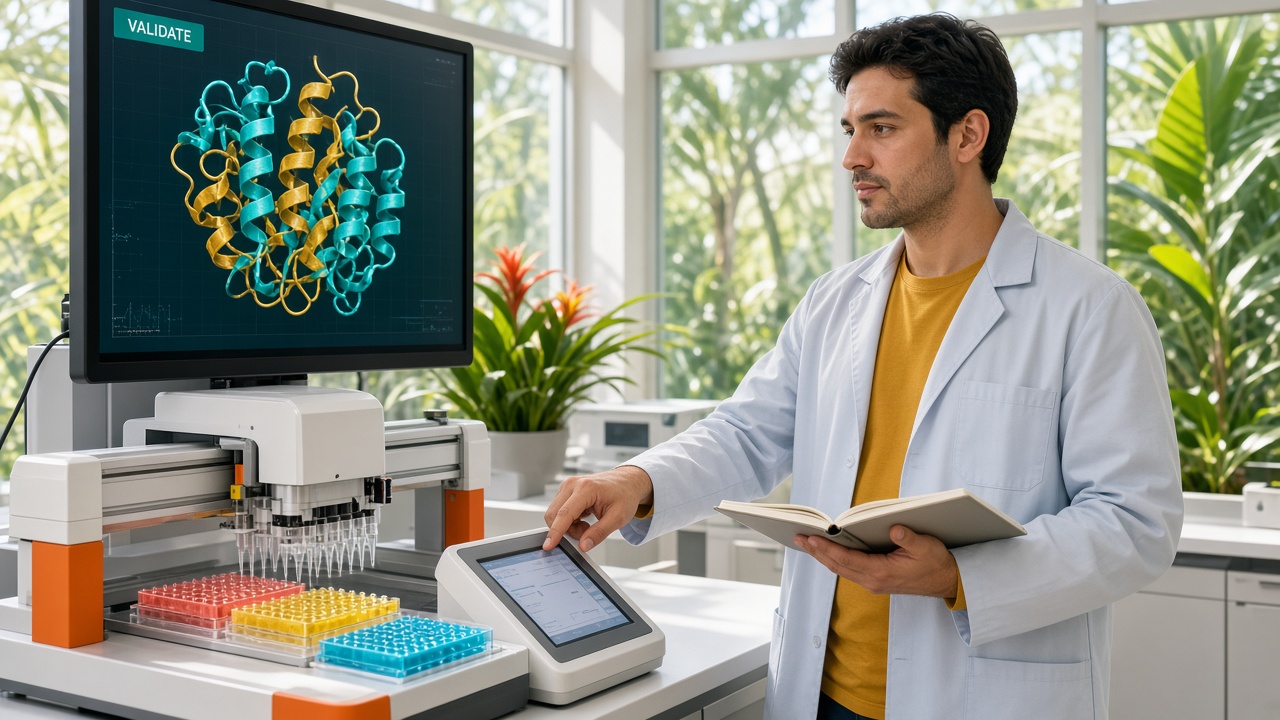
You do not need to become a generic engineer. Here is how scientists are moving into computational biology, lab automation, drug-discovery AI and data roles.
A lot of scientists hear "learn AI" and picture a complete identity change: leave the bench, disappear into a coding bootcamp, come back as someone else. That is the wrong picture, and it is making good people delay a move they could start this month.
The roles companies are actually struggling to fill sit next to the science you already know. Computational biology. Lab automation. AI for drug discovery. Translational and clinical data. These jobs reward a scientist who can add a practical layer of coding, data and machine-learning judgement, not a generic software engineer who has never looked at a messy biological dataset.
If that is you, the door is more open than it looks.
What employers want, in their own words
Benchling's 2026 Biotech AI Report surveyed about 100 biotech and biopharma organisations in the US and Europe that are already using AI in R&D. Their top hiring priority was not "an AI person". It was data scientists with life-sciences domain knowledge, then computational biologists with AI expertise, then AI engineers who can deploy models. Karen Akinsanya, president and head of therapeutics R&D at Schrödinger, put the hard part plainly in that report: every company is using AI in some way, and "the biggest challenge is talent, people who can navigate both science and ML."
Those organisations are trying to grow that talent from the inside. Sixty-seven percent pointed to internal upskilling as their main source of AI people, against 21 percent who said they hire in from tech. That should encourage you if you are already in a science team. It should also tell job-seekers what to emphasise: you are not late because you did not spend five years at a consumer tech firm. Domain knowledge is the scarce ingredient.
Recruiters are saying the same thing out loud. In a September 2026 BioSpace interview, Darren Nelson of Recruits Lab named three biopharma data roles in especially high demand: computational biologists for genomic data, AI and machine-learning discovery scientists for predictive drug modelling, and translational data scientists for clinical and real-world evidence. The technical baseline he described will not surprise you: Python and R, plus tools such as Biopython, RDKit and PyTorch, and the unfashionable plumbing of SQL, cloud and containers. The skill that quietly separates candidates is the ability to translate a result into language a biologist, chemist or executive can use.
BioSpace's later piece on AI hiring added a test I would steal for your own preparation. What biological data have you worked with? What did you personally build? Did scientists actually use the output to make a decision? How did you validate it? What happened when the model was wrong? Those questions are a career plan disguised as an interview.
The wider labour market backs the direction of travel. The US Bureau of Labor Statistics projects data scientist employment to grow 35 percent from 2025 to 2035, adding about 95,400 jobs. You do not have to become "a data scientist" in the abstract. You do have to get comfortable enough with data that a science employer can picture you in the room where the model meets the experiment.
Four adjacent paths, not one leap
You do not need to pick the trendiest title. You need the path that is a short, honest step from the work you already do.
Computational biology and bioinformatics. If your days already involve sequencing, omics, imaging or any dataset too big to live in a spreadsheet, this is the natural pivot. BioSpace's 2025 look at bioinformatics hiring found demand rising for people who can handle multiomics, not only genomics, and for engineers who can build cloud pipelines as well as interpret a result. Single-cell analysis, scalable workflows and machine-learning models that predict a drug response all sit in this family. On Sciencework you will find it under AI for science and data and quantitative jobs, including recent bioinformatics roles at employers such as Veracyte, Natera, Twist Bioscience and Flagship Pioneering.
AI for drug discovery. This is computational work with a product at the end of it: a molecule, a protein design, a target, a better experiment to run next. You still need to know enough chemistry or biology to spot a plausible answer from a pretty one. As of mid-November 2026, Sciencework is listing computational chemistry, protein design and machine-learning scientist roles at companies including Isomorphic Labs, Generate Biomedicines, A-Alpha Bio and insitro. You will not walk into the most senior of those jobs on enthusiasm alone. You can walk toward them by showing one well-documented project that removes a real bottleneck, even if you built it in your current lab.
Lab automation and closed-loop experiments. If you are a careful experimentalist who likes instruments, this path is underrated. As models propose more hypotheses, someone has to turn those proposals into robust, repeatable runs. Nature has reported the lively debate around self-driving "robot labs", and the consistent point from researchers is that human skills remain essential. The growing job is the scientist who can design the assay, supervise the robot, and decide whether the output is worth trusting. Look at automation roles on Sciencework, from Automation Scientist at LabGenius in London to laboratory automation engineering roles at Natera, Ginkgo Bioworks and Generate Biomedicines.
Translational, clinical and data science roles. If you are close to trials, biomarkers, biostatistics or real-world evidence, you are already standing on a growing pathway. These jobs connect discovery to patients, and they are one of the three demand pockets biopharma recruiters keep naming. They also sit naturally beside medical affairs and regulatory and quality if your strength is judgement and communication rather than model-building.
A practical way to reskill without quitting your job
You do not need a second degree before you start. You need a tight, visible body of work.
In the first month, get fluent in the basics you will be asked about in every screen: Python or R (both if you can), clean data wrangling, and one notebook that starts with a raw public dataset and ends with a result you would be willing to defend. If you are on the biology side, work with a genomic, structural or assay dataset. If you are on the chemistry side, try a small molecular property or docking-related project. Keep it modest and real. A finished, reproducible analysis beats a half-built "foundation model".
In the second month, add one tool that matches the path you want. For computational biology, that might be a Nextflow or Snakemake pipeline, or a cloud workflow you can run again from a README. For discovery AI, it might be a simple model in PyTorch, with a clear baseline and an honest discussion of failure cases. For automation, it might be scripting an instrument, writing a better electronic-lab-notebook workflow, or documenting how you reduced a manual step. Employers are not looking for magic. They are looking for evidence that you can make a process more reliable.
In the third month, put the work where a hiring manager can see it: a short write-up, a public repository with a clean README, a talk in your group, or an internal tool people actually use. Then translate it into the language of a job advert. "I built a pipeline that cut a two-day analysis to a two-hour run and caught a batch effect we had been missing" is a better sentence than "familiar with AI".
Two habits matter as much as the stack. First, become a serious checker of AI output. The Google and Google DeepMind study of AI in science found that 89 percent of scientists who saved time with AI spent more than a tenth of that saved time verifying outputs, and 46 percent spent more than a quarter of it on checking. Verification is not a side chore. It is a professional skill, especially in the life sciences, where the study found that "verification tax" was particularly high. Second, practise explaining your work to someone who does not share your specialism. If a chemist, a clinician or a programme lead cannot use your result, it is not finished.
How to make the move
If you are already inside a company, ask for the adjacent work before you ask for a new job. Benchling's finding on internal upskilling is your opening. Offer to pair with the computational team on one project. Volunteer to own the analysis for the next screen. Help a colleague automate a painful step. A lot of "AI talent" is a scientist who stood closer to the data until the job description caught up.
If you are applying from academia or from a purely experimental role, do not hide your science and try to look like an engineer. Lead with the problem you know how to solve, then show the tools you have added. Tailor each application to the path above, not to a generic "data" advert. And look at jobs by pathway, not only by keyword. A role that looks like industry research may be the right first step if the team already uses models at the bench. A role listed under AI for science may still need a strong experimentalist.
I am optimistic about this pivot because it does not ask you to abandon your training. It asks you to aim that training at the part of the workflow where science and software now meet. That is exactly where the hiring pressure is.
Browse AI for science jobs or data and quantitative roles on Sciencework, and set up a free talent profile so employers can find you.