Where Science Jobs Are Flowing as AI Reshapes Research
AI is speeding up parts of research and moving the bottlenecks. Here is where science jobs are growing, which roles are changing, and why your training counts.
If you work in science, you can already feel the shift. AI is in the literature review, the code, the structure prediction and the first draft of the methods section. That is not a forecast. It is Tuesday afternoon in a lot of labs.
The useful question is not whether AI will "take" science jobs. The useful question is where the work is flowing, which roles are growing, and which ones are changing shape. Because the early evidence is more interesting than the scare headlines. Scientists are getting time back. Then the bottleneck moves somewhere else, usually toward work that still needs a trained person: running the experiment, checking the output, talking to a clinician, getting a product approved.
That is a better story for your career than either panic or hype.
What the data actually says
A Google and Google DeepMind study published in September 2026, with MIT FutureTech, looked at about 360,000 science-related Gemini interactions, more than 2,600 specialised scientific models, and a survey of 637 active researchers in the United States and the United Kingdom. Nearly half of those scientists said they already use some form of AI every day. Around three quarters reported a net time saving, averaging about 6.9 hours a week, and most of that time went back into research. About eight in ten said their lab output had risen over the previous three years, and 89 percent expected further gains.
That sounds like a productivity boom. In parts of the workflow, it is. The same study is honest about the catch. More than four in ten of the scientists surveyed said their main constraint had moved downstream over the previous two years, into lab execution, clinical validation and field data collection. Forty-one percent reported a growing backlog of untested hypotheses. Of the people who saved time with AI, 89 percent spent more than a tenth of that saved time checking the outputs, and 46 percent spent more than a quarter of it on checking.
In plain language: models are good at proposing and drafting. Someone still has to test, verify and decide. That "someone" is a job.
A second data point should calm the most anxious reading of this moment. SThree's 2026 STEM Workforce Report, based on a YouGov survey of 4,126 STEM professionals in the UK, US, Germany, the Netherlands and Japan, found that 77 percent of respondents who had seen AI-related job cuts said their organisation had reversed them or planned to. In life sciences, that figure rose to 90 percent. Junior hiring was not collapsing either: 34 percent of respondents had seen junior-level hiring increase over the previous 12 months, against 14 percent who had seen it fall.
The warning in that report is more subtle, and I think it is the right one. Thirty-two percent said senior staff were now doing work that used to sit with juniors, and 40 percent said heavy dependence on AI was putting the junior pipeline at risk. Hiring can look healthy while the learning ladder quietly loses rungs. If you manage a lab or a science team, protect the tasks that teach judgement. If you are early in your career, look for employers who still let you do them, with AI beside you, not instead of you.
Where the jobs are growing
Start with the official labour market, not the anecdote. The US Bureau of Labor Statistics projects employment of data scientists to grow 35 percent from 2025 to 2035, adding about 95,400 jobs, with a 2025 median wage of $120,230. That is one of the fastest-growing occupations in the entire US economy, far ahead of the 3.5 percent average for all jobs. Medical scientists are projected to grow 13 percent over the same period, adding about 22,700 jobs, with a 2025 median of $103,410. Epidemiologists are projected to grow about 19 percent, and computer and information research scientists about 22 percent.
Those are broad categories, but they point in a clear direction. Quantitative work, health research and computing applied to scientific problems are expanding. The interesting bit is how that demand shows up inside science companies.
BioSpace reported in September 2026 that biopharma recruiters are hunting hardest for three kinds of data person: computational biologists who can work with genomic data, AI and machine-learning scientists who can do predictive drug modelling, and translational data scientists who can analyse clinical trials and real-world evidence. A companion BioSpace piece on AI hiring put it even more sharply: the hardest people to find are not "pure" biologists or "pure" engineers. They are people who can stand in the gap, scientists who understand models and engineers who understand biological data.
Benchling's 2026 Biotech AI Report, based on a survey of about 100 US and European biotech and biopharma organisations already using AI, found the same pattern. The top talent priority was data scientists with life-sciences domain knowledge, followed by computational biologists with AI expertise and AI engineers who can build and deploy models. Sixty-seven percent of those organisations said internal upskilling was their main source of AI talent, against 21 percent who pointed to hiring in from tech. In other words, companies would rather teach a scientist the tools than teach a generic technologist the biology.
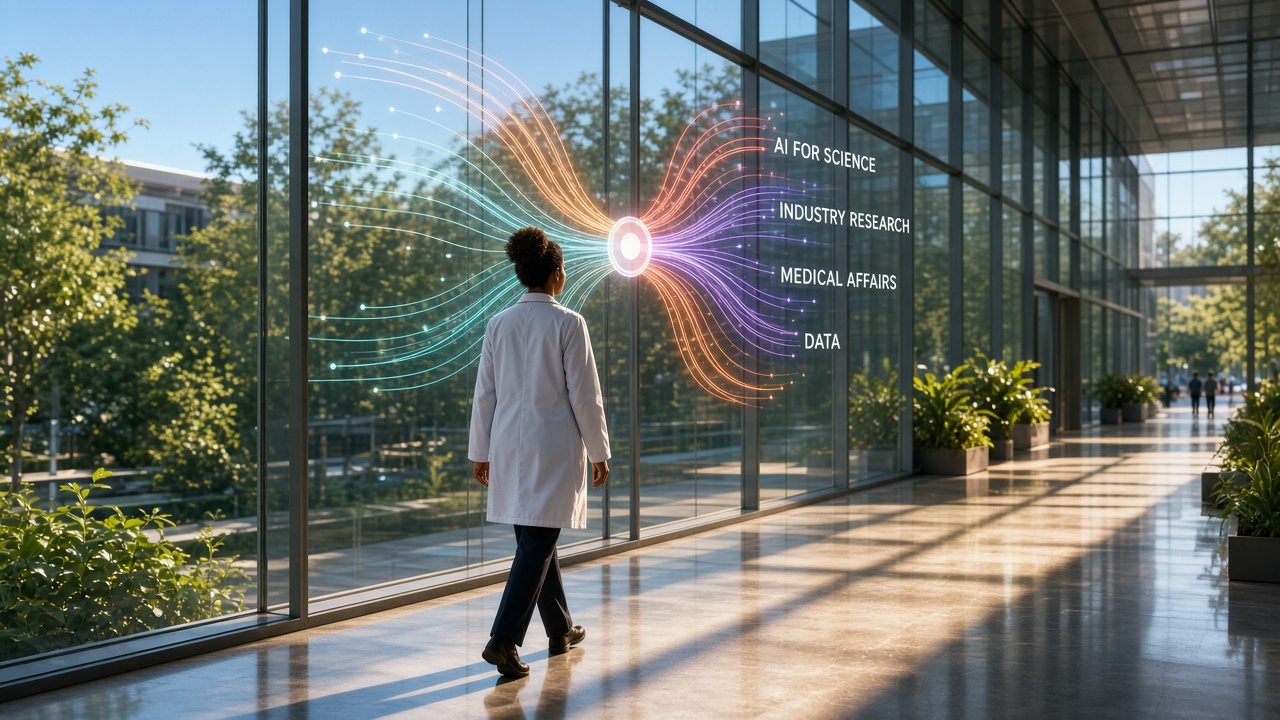
You can already see that demand on Sciencework. As of mid-November 2026 the board is carrying more than 1,100 live science roles. Industry research is the largest pathway. Just behind the familiar bench and discovery jobs, you will find a thick seam of AI for science and data and quantitative roles, including machine-learning and computational positions at employers such as Isomorphic Labs, insitro, Flagship Pioneering and Generate Biomedicines. Those listings will change week by week. The shape of the demand is steadier: models, data and domain knowledge, together.
Where the work is changing, not disappearing
It would be sloppy to say bench science is safe and desk science is doomed. Both are being redesigned.
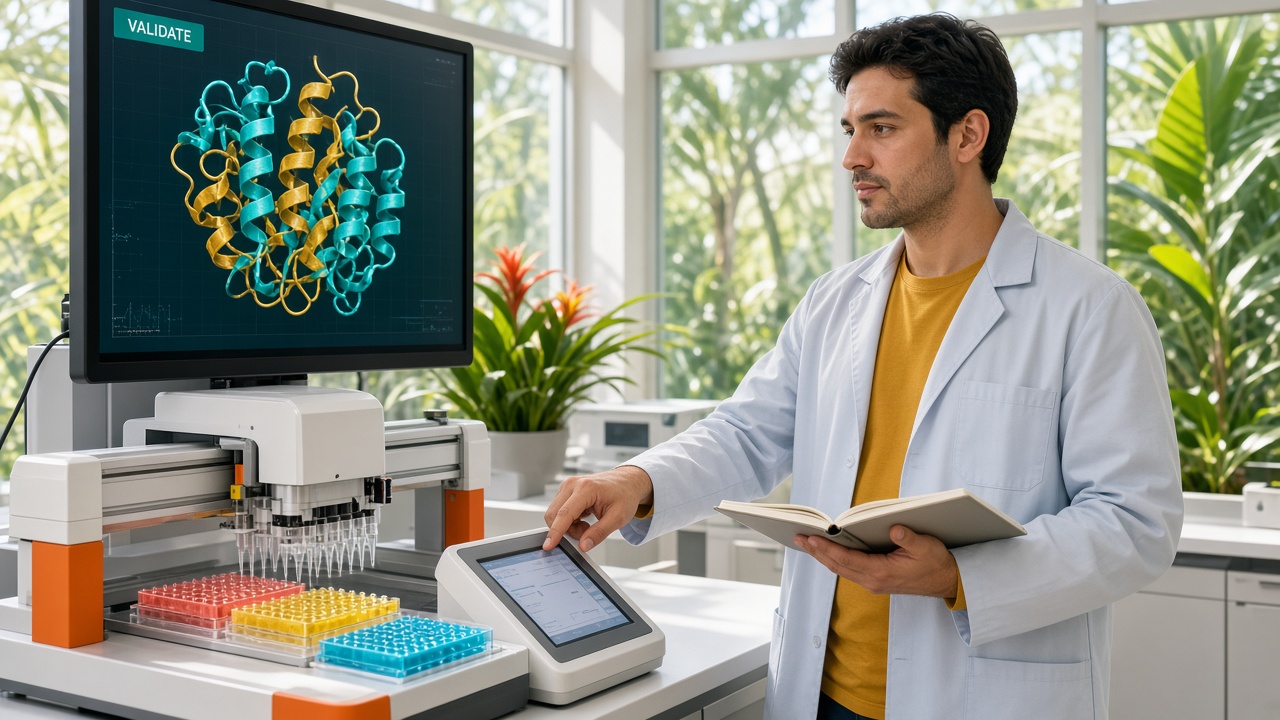
Hands-on experimental work is not going away. If anything, the Google study suggests it is becoming more precious, because hypothesis generation is getting cheaper than hypothesis testing. Self-driving and highly automated labs are arriving, and Nature's coverage of that debate has been clear that human skills remain essential: setting the question, interpreting the result, deciding what is worth the cost of a physical test. The job title on the door may still say "scientist". The Tuesday may involve more time designing a run for a liquid handler, reviewing an automated output and asking whether the biology makes sense.
That is why lab automation roles are showing up alongside classic bench jobs, at companies such as LabGenius, Natera, Ginkgo Bioworks and Generate Biomedicines. The person who understands the assay and the robot is suddenly very employable.
Analysis and modelling work is changing too, and this is where people get nervous. Some routine cleaning, plotting and first-pass modelling can now be drafted by a tool. The work that remains, and the work that is growing, is harder: building a reproducible pipeline, spotting when a model is confidently wrong, choosing the right specialised model for a protein, a material or a forecast, and explaining the limit of the answer to a chemist, a clinician or a regulator. If your current role is "I run the same analysis every week and hand over a plot", you should add skills. If your role is "I decide whether this result is real", you are closer to the work employers will pay for.
Where judgement jobs keep growing
Not every growing science job has "AI" in the title, and that is easy to miss.
When models produce more candidates, more drafts and more hypotheses, organisations need more people who can translate, test and stand behind a decision. On Sciencework that shows up clearly in medical affairs, regulatory and quality and writing and communication. These are roles for scientists who can explain evidence to doctors, get a product through approval, or write with the precision a regulator will accept. AI can help with a first draft. It does not hold the accountability.
The same logic applies to venture and analysis, where someone has to judge whether a scientific claim is investable, and to climate and energy, where the questions are messy, physical and tightly tied to real-world data. If you like science but do not want to live at the bench or in a notebook full of models, these pathways are not a consolation prize. They are part of how scientific work reaches the world.
What I would do with this, if it were my career
First, stop treating "AI skills" as a separate identity. The scientists getting hired can frame a good question, work with data, and tell a non-specialist what the answer is worth. Python or R helps. So does a serious understanding of your domain. The combination is the asset.
Second, look at jobs by the kind of work, not only by the title. A computational biologist, a lab automation scientist, a medical writer and a quality lead may not look like the same career family on a CV. On a site like Sciencework they are all ways of using a science training. Start with the 12 pathways, then search for a method you already know.
Third, if you manage people, do not let AI hollow out the junior year. The SThree research is a warning, not a reason to stop hiring. Keep the tasks that build judgement, and be explicit about them.
The optimistic reading is also the realistic one. AI is making parts of research faster. That shifts work toward testing, verification, translation and the messy physical world. Those are science jobs. A lot of them are open now.
Browse live science jobs on Sciencework, or go straight to AI for science, industry research or data and quantitative roles.